On this page
What does a BPC-157 certificate of analysis tell you?
A COA reports tests on a named batch. Start with the lot number, the product format and the actual results. A purity percentage alone cannot answer how much BPC-157 is present, whether a device delivers its labeled amount or what the product does in humans.
The two original reports below cover a 10 mg powder vial and 500 mcg capsules. Both explicitly identify PrymaLab's in-house laboratory; neither is an independent third-party report. Their scope is the named lot and sampled units.1, 2
Where can I download the original BPC-157 COAs?
Open either preview to inspect both pages, including methods, peak tables and approvals. These are the original, unaltered PDFs. The percentages below are reported results; document inconsistencies are identified in the batch-results section.
10 mg Vial COA
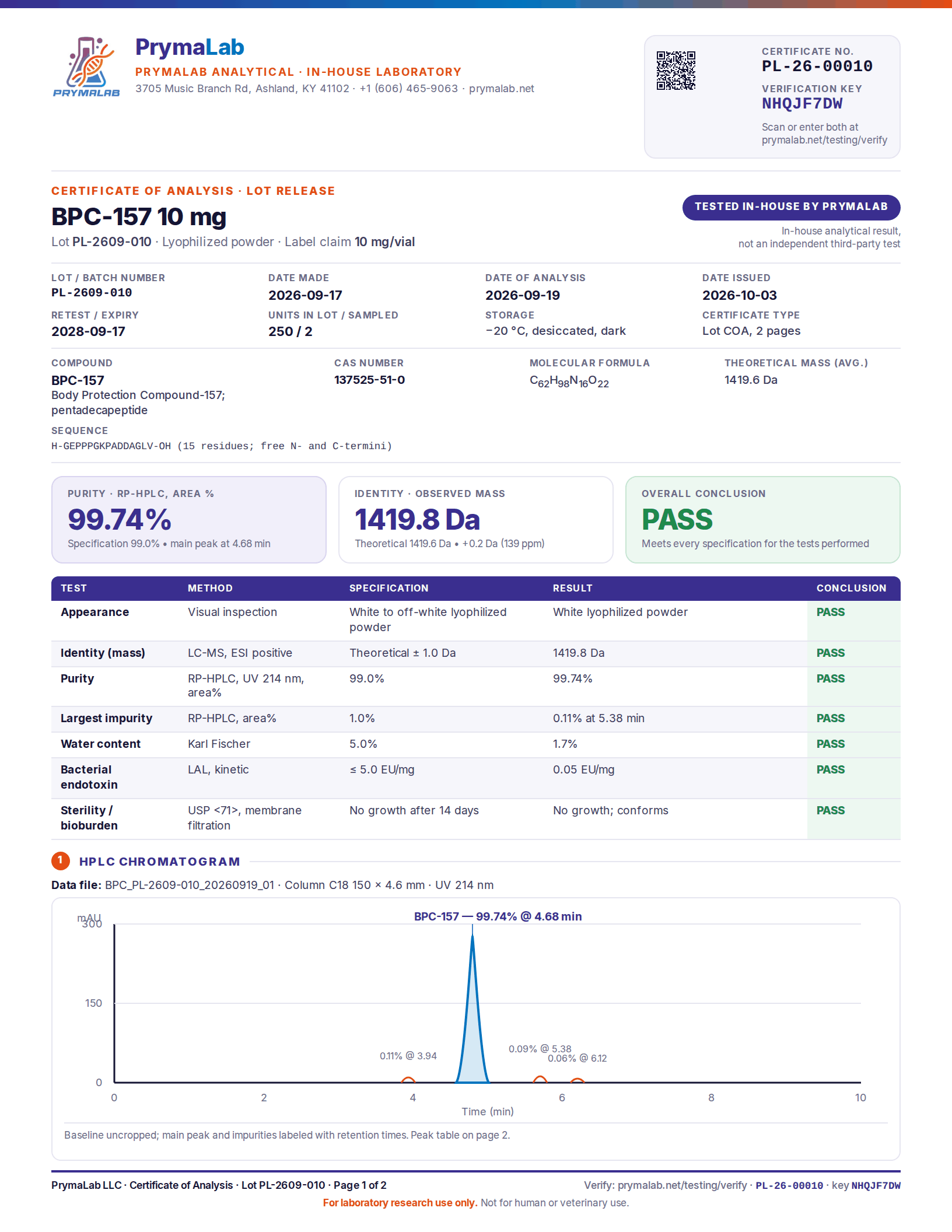
In-house testing. The 10 mg amount is a label claim, without a separate content-assay result.
500 mcg Capsule COA
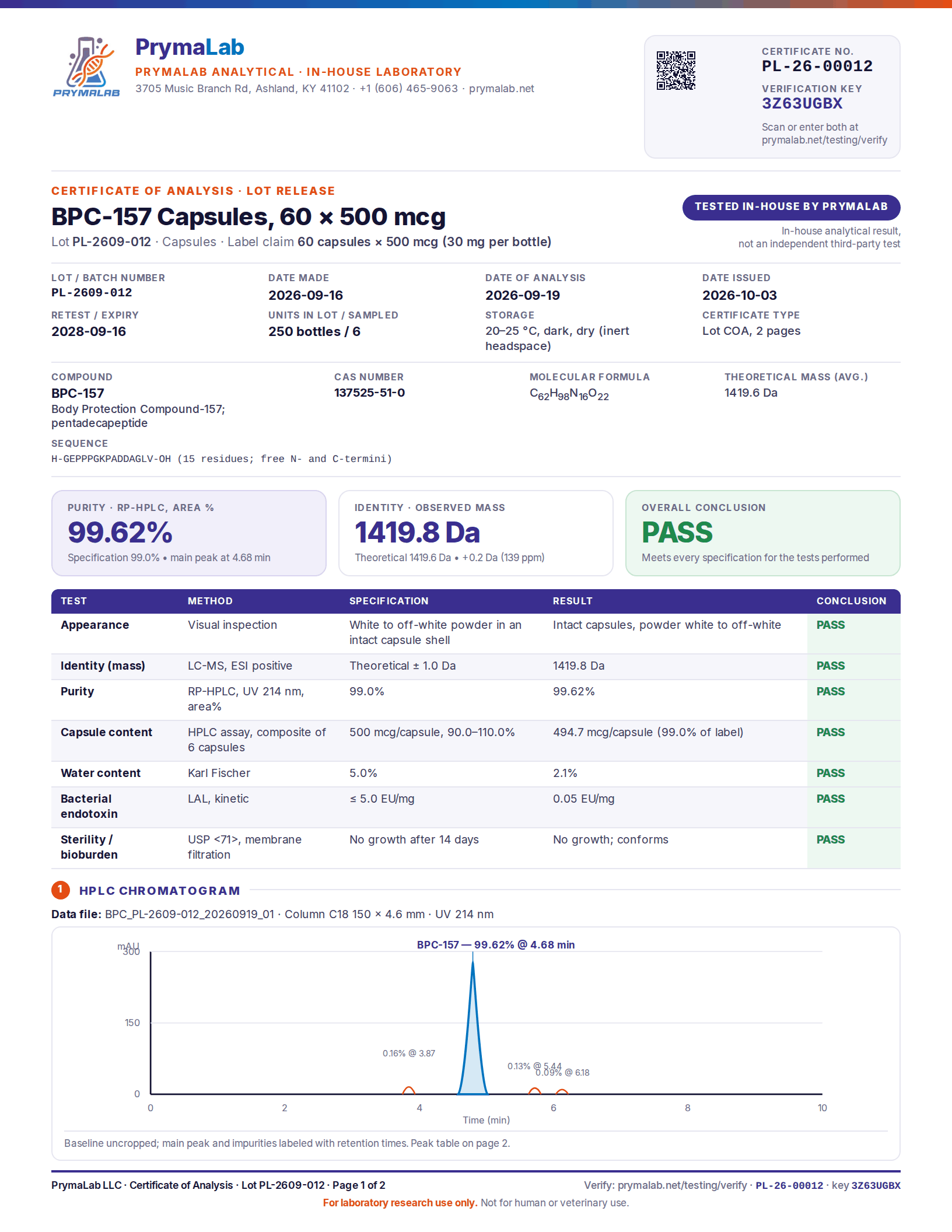
In-house testing. A six-capsule composite assay reports 494.7 mcg per capsule on average.
Which product does each document cover?
The vial and capsules have separate batch reports. The pen and nasal spray need documentation for their own finished formulation.
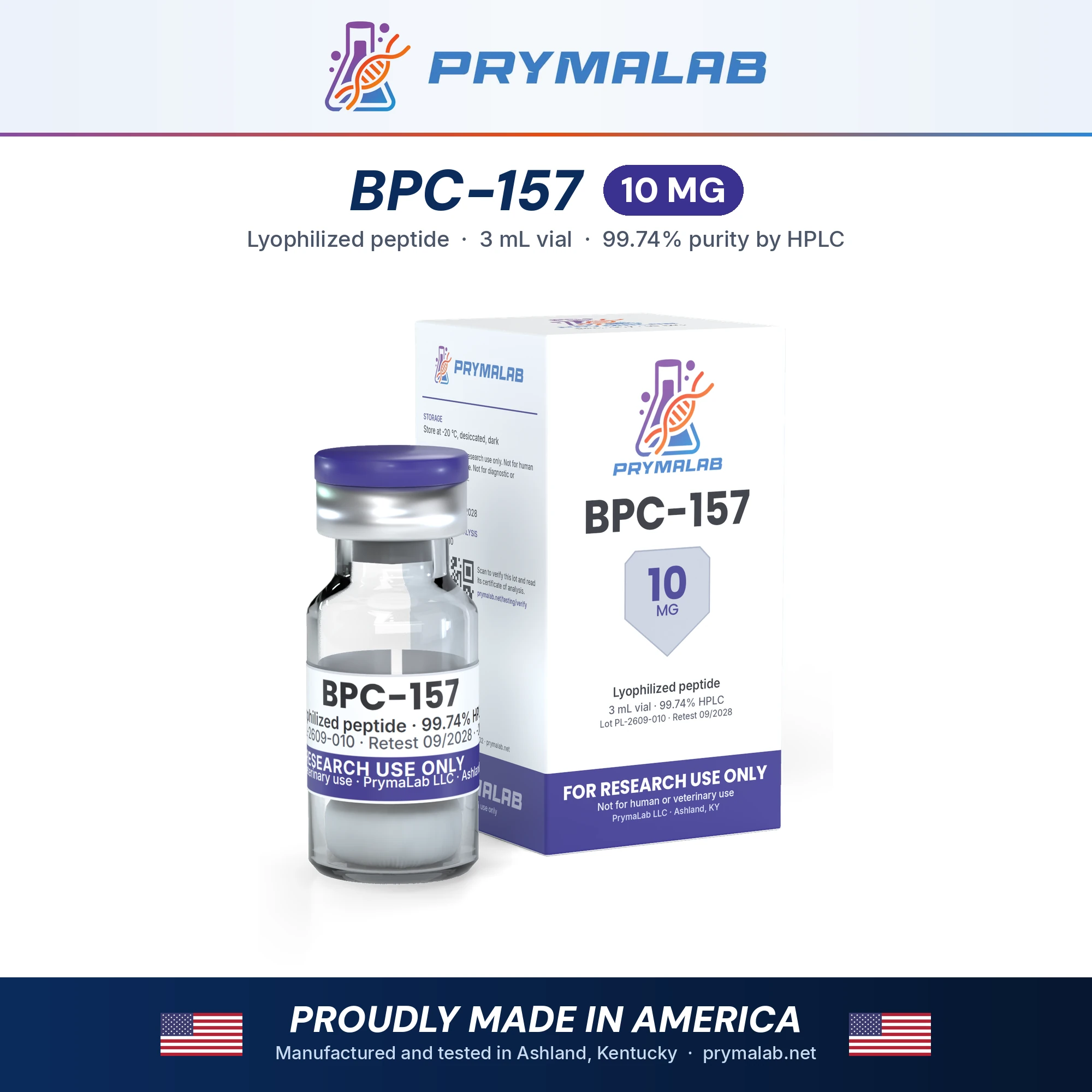
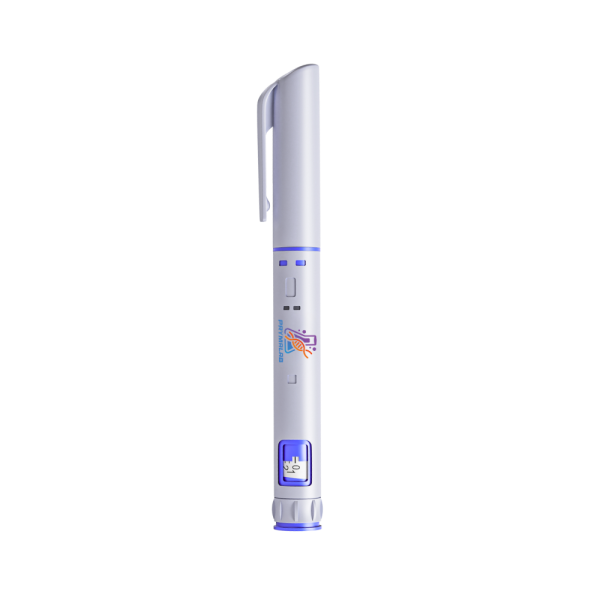
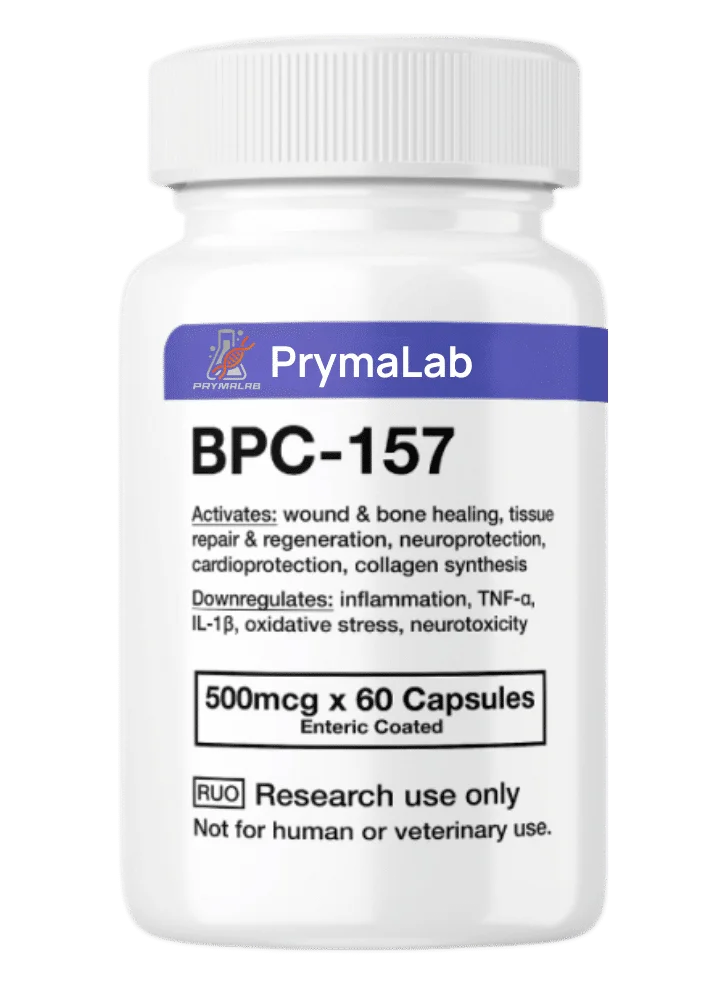
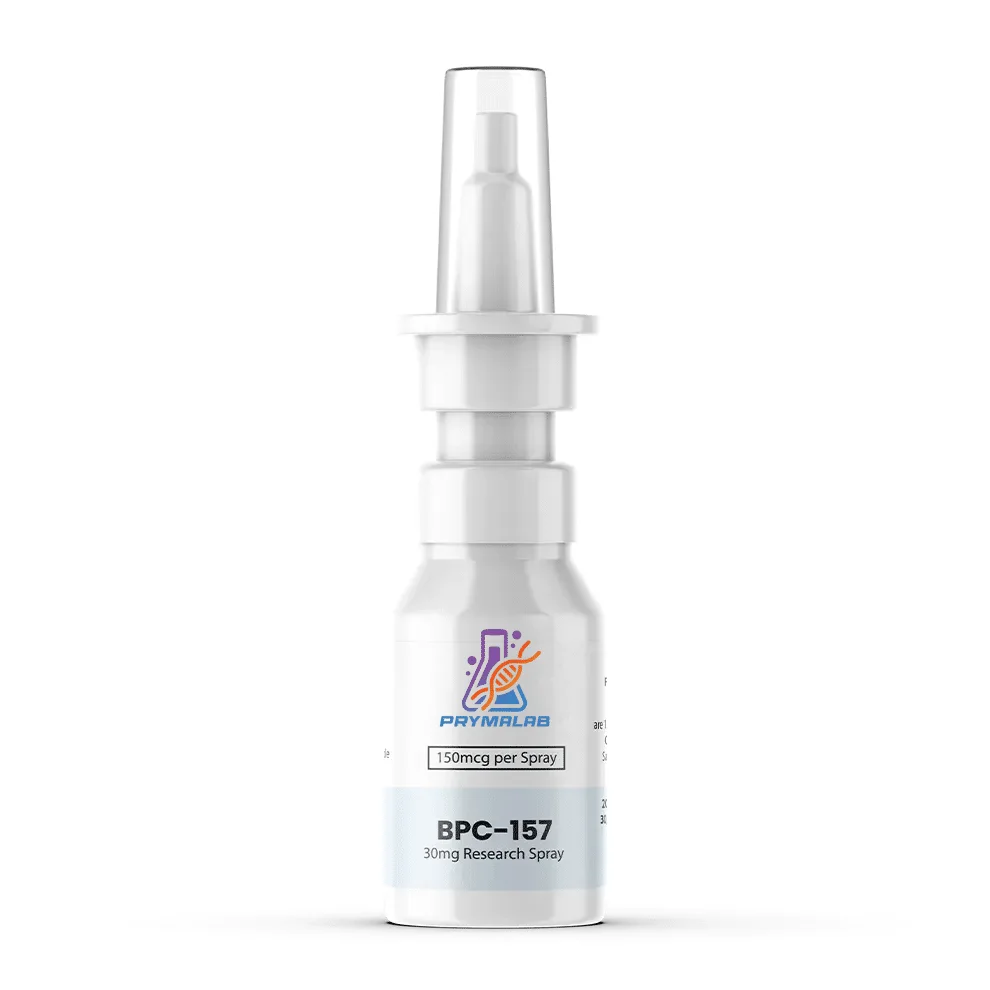
The vial and capsule have separate in-house batch reports. Those documents do not certify the finished pen or spray.
What do the vial and capsule certificates actually report?
| Test or claim | Vial · PL-2609-010 | Capsules · PL-2609-012 |
|---|---|---|
| Appearance | White lyophilized powder | Intact capsules; white to off-white powder |
| Identity by LC-MS | 1419.8 Da observed | 1419.8 Da observed |
| RP-HPLC area purity | 99.74% | 99.62% |
| BPC-157 content | 10 mg/vial label claim; no separate assay result | 494.7 mcg/capsule; six-capsule composite, 99.0% of label |
| Water, Karl Fischer | 1.7% | 2.1% |
| Bacterial endotoxin, kinetic LAL | 0.05 EU/mg | 0.05 EU/mg |
| Reported sterility/bioburden test | No growth; conforms | No growth; conforms |
Both reports describe the microbiology method as USP <71> membrane filtration with a 14-day no-growth specification. These are separate reported tests, not conclusions inferred from HPLC purity.
Vial document check: the summary places its 0.11% largest impurity at 5.38 minutes. The chromatogram and peak table instead place 0.11% at 3.94 minutes and 0.09% at 5.38 minutes.
Capsule document check: the four printed peak areas sum to 4,290,000, while the total row says 4,300,000. The stated 99.62% aligns with the summed areas, not that printed total. Both inconsistencies warrant clarification from the issuing laboratory; we have not altered or replaced either certificate.
Does 99% purity prove there is 10 mg in the vial?
No. HPLC area purity and the amount of peptide are different measurements. These reports calculate purity from the main peak's area divided by total integrated peak area. A 99.74% result does not establish the vial's fill mass, and multiplying the 10 mg label by 99.74% does not produce a verified content assay.1
The capsule report supplies a separate content result: 494.7 mcg per capsule from six capsules combined. That pooled average does not show the amount in each capsule. Page two names a “content & uniformity” report, but neither individual capsule measurements nor a uniformity acceptance result is displayed. ICH quality guidance treats strength/content and dosage-unit uniformity as distinct tests.2, 3
The identity result is also specific: both reports list 1419.8 Da against a theoretical 1419.6 Da, within their stated ±1.0 Da limit. Their sequence and formula are identified as literature reference values. Neither a matching mass nor a high HPLC percentage establishes human efficacy, absorbed dose or clinical safety.
Does one BPC-157 COA cover the vial, pen, capsules and spray?
Each finished format needs evidence relevant to that format. The reviewed pen and spray specifications refer to peptide-lot testing; no matching finished-device COA was linked in the reviewed records.9
| Format and label | Available coverage | What it does not establish |
|---|---|---|
| 10 mg powder vial | PL-2609-010 lot COA | Separate 10 mg content assay; stability after mixing |
| 60 × 500 mcg capsules | PL-2609-012 lot COA, including composite content | Individual capsule uniformity or human absorption |
| 15 mg pen · 3 mL | No reviewed finished-pen COA | Measured solution strength, delivered amount per click or finished-device microbiology |
| 30 mg spray · 150 mcg/spray | Original label and spray SDS; no reviewed finished-spray COA | Measured spray output, usable spray count or finished-device microbiology |
A powder report cannot certify what happens after formulation, filling and dispensing. FDA nasal-product guidance evaluates the formulation and pump together, including delivered content and spray uniformity. It is general quality guidance, not certification of this BPC-157 spray.4
How do I check whether a COA matches my product?
- Match the lot exactly. PL-2609-010 covers the named vial lot; PL-2609-012 covers the named capsule lot. A product name alone is insufficient.
- Match the format and strength. A capsule certificate cannot authenticate a spray or pen made from the same peptide.
- Check both pages and the report number. Look for methods, numerical results, dates, sample information and the issuing laboratory. Both originals here were issued October 3, 2026.
- Check who performed the tests. Both explicitly say in-house and list no attached outside-laboratory reports. “Tested” does not mean independently tested.
- Resolve inconsistencies before relying on a result. Request clarification and underlying test records when totals or summary values disagree.
An in-house COA can provide useful batch information. Its independence and the authenticity of its underlying raw data are separate questions; reproducing the original PDF does not independently verify the laboratory work.1, 2
Does an SDS prove quality or tell me the shelf life?
An SDS describes chemical hazards, handling and storage. It is not a batch COA. OSHA's SDS format places handling and storage in Section 7; a hazard-classification statement does not establish therapeutic safety.7
| Original handling document | What it specifies | What remains unspecified |
|---|---|---|
| Vial SDS · PL-SDS-019 | Sealed powder: −20°C, dry and protected from light. Reconstituted solution: 2–8°C, protected from light. | No universal days-after-mixing period; it refers to the period established by the laboratory. |
| Spray SDS · PL-SDS-021 | 2–8°C, protected from light, upright and capped; do not freeze. | No verified after-opening expiry or actual bottle volume. |
The vial COA prints a retest/expiry date of September 17, 2028; the capsule COA prints September 16, 2028 and storage at 20–25°C, dark and dry. Those issuer-assigned dates do not establish a shelf life after opening, mixing or transferring the contents.1, 2
For preparation details, use the reconstitution guide and spray handling guide. The COA's chromatography sample diluent and 0.5 mg/mL analytical concentration describe laboratory measurement conditions; they are not a product-use protocol.1, 5, 6
Does the BPC-157 + TB-500 blend have a separate COA?
Yes—the 10 mg + 10 mg Wolverine vial has its own report. Lot PL-2609-011, certificate PL-26-00011, reports 99.65% combined HPLC area purity across the two component peaks. It is also in-house testing and does not certify the finished Wolverine pen.8
Open the original Wolverine vial COA or read the stack-specific quality explanation.
Which original documents support this guide?
- Original BPC-157 10 mg vial COA · PL-26-00010Lot PL-2609-010; two pages; issuer-reported identity, purity, water, endotoxin and microbiology. Includes the noted impurity-retention-time discrepancy.
- Original BPC-157 capsule COA · PL-26-00012Lot PL-2609-012; two pages; six-capsule composite assay and other reported tests. Includes the noted peak-area-total discrepancy.
- ICH Q6A · Specifications, test procedures and acceptance criteriaGeneral quality concepts: identification, content assay, impurities and dosage-unit uniformity are distinct attributes.
- FDA · Nasal spray and inhalation product quality guidanceFormulation/device performance, pump delivery and spray-content uniformity; not a BPC-157 product approval.
- Original BPC-157 powder SDS · PL-SDS-019Revision 1.0, October 3, 2026; Section 7 laboratory handling and storage.
- Original BPC-157 spray SDS · PL-SDS-021Revision 1.0, October 3, 2026; Section 7 handling and storage. Nominal volume in hazard calculations does not verify the bottle's actual fill.
- OSHA · Hazard Communication Safety Data SheetsExplains the purpose and contents of an SDS.
- Original Wolverine 10 mg + 10 mg vial COA · PL-26-00011Lot PL-2609-011; blend-specific in-house results.
- Featured pen specifications and nasal spray specification recordOriginal labels and product documentation reviewed November 2, 2026. No matching finished-pen or finished-spray COA was publicly linked in the reviewed records.