On this page
What is the BPC-157 + TB-500 Wolverine stack?
Wolverine is the name for pairing BPC-157 with TB-500. People discuss the combination for shoulder, knee, tendon and other soft-tissue problems, especially when discomfort limits training or everyday movement.
The featured products have a 1:1 ratio by weight. The vial contains 10 mg BPC-157 plus 10 mg TB-500; the pen contains 20 mg of each in 3 mL. “20 mg Wolverine” therefore means 20 mg of combined ingredients, not 20 mg of BPC-157.
A premixed blend keeps the ingredient ratio fixed. Separate vials allow different ingredient quantities and frequencies, so a separate-vial schedule cannot automatically be copied onto a Wolverine pen or blend vial. The single-ingredient BPC-157 dosage guide covers BPC-157 on its own.
Wolverine products: the 20 mg vial and 40 mg pen
Compare the amount of each ingredient, the total contents and the preparation required.
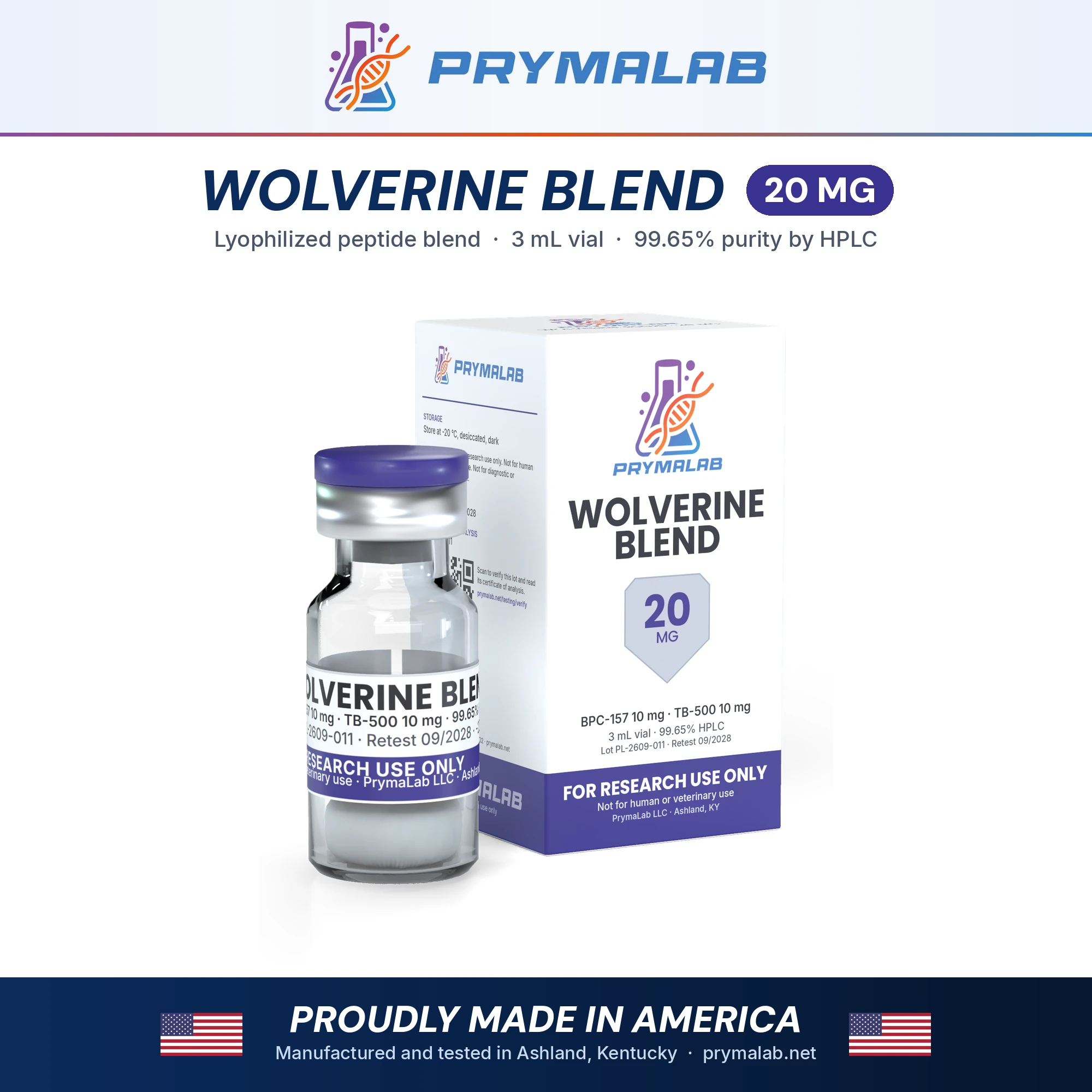
Wolverine 20 mg Vial
A freeze-dried, equal-weight blend with an original vial-batch certificate.
- BPC-157
- 10 mg
- TB-500
- 10 mg
- Combined quantity
- 20 mg
- Preparation
- Reconstitution required
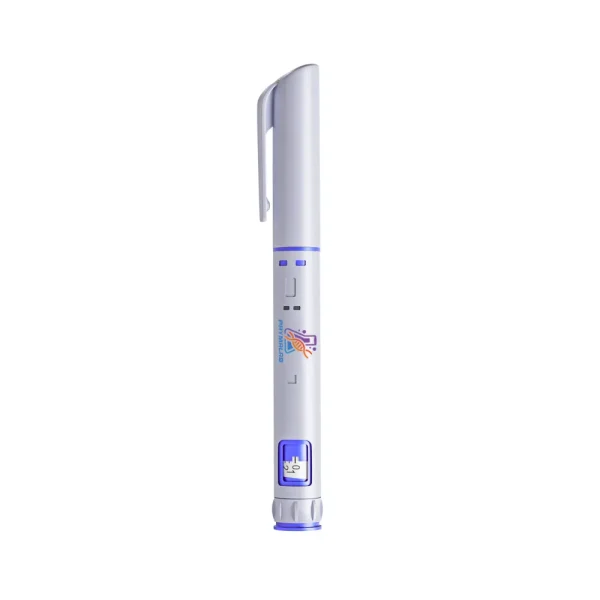
Wolverine 40 mg Pen
The same 1:1 ingredient ratio in a prefilled liquid autoinjector format.
- BPC-157
- 20 mg
- TB-500
- 20 mg
- Total / liquid volume
- 40 mg / 3 mL
- Combined concentration
- 13.33 mg/mL
Product links open the dedicated Wolverine website. The vial certificate applies to its stated powder batch.
What does combining BPC-157 and TB-500 do?
Reported goals include less joint discomfort, easier movement and a return to previously painful exercises. Laboratory work investigates cell migration, collagen organization and tissue repair. These are promising areas of research, with a much smaller human evidence base.
| Research | What was observed | What it answers |
|---|---|---|
| Human knee-pain series | Three of four patients receiving BPC-157 with thymosin beta-4 reported improvement.1 | Early pain observations after clinical joint injections; no control group or standardized function score. |
| Rat Achilles-tendon experiment | Peptide groups showed improvements in tissue measures. The combination gave no additional benefit over either ingredient alone.2 | Direct combination research in an animal injury model, not proof of human synergy. |
| BPC-157 tendon-cell research | Greater tendon-cell migration, tissue outgrowth and survival under oxidative stress.3 | A possible repair mechanism for one ingredient. |
Is Wolverine better than BPC-157 alone?
A clinical advantage has not been established. The small knee series cannot rank the treatments: its groups were tiny and were not randomized. The animal combination experiment also did not show an added benefit. The practical difference is that Wolverine supplies two ingredients together; evidence does not justify promising faster healing because it contains two.12
Does “500 mcg” mean 500 mcg of BPC-157 and TB-500 each?
Only if the source explicitly says “each.” In the featured equal-weight blend, 500 mcg combined contains 250 mcg BPC-157 and 250 mcg TB-500. A statement of 500 mcg each describes twice as much combined material.
| Combined amount | BPC-157 | TB-500 |
|---|---|---|
| 500 mcg | 250 mcg | 250 mcg |
| 1 mg / 1,000 mcg | 500 mcg | 500 mcg |
| 2 mg / 2,000 mcg | 1 mg | 1 mg |
A 10 mg blend and a 20 mg blend can have the same ratio but different concentrations after mixing. Read both ingredient amounts and the final solution volume before applying a dosage-in-units chart.
BPC-157 + TB-500 dosage per day, per week and per course
A documented blend example is 500 mcg BPC-157 + 500 mcg TB-500 once daily for four weeks. Another author reported 500 mcg of combined blend twice daily. Both descriptions total 1 mg combined per day, although the second author did not confirm the blend ratio.45
| Reported schedule | Daily amount | Weekly total | Reported duration / course total |
|---|---|---|---|
| Once-daily 1:1 blend4 | 500 mcg BPC-157 + 500 mcg TB-500 | 7 mg combined: 3.5 mg each | 4 weeks: 28 mg combined, 14 mg each |
| Blend split morning / evening5 | 500 mcg combined twice daily | 7 mg combined; ingredient split unstated | 4 weeks at initial update: 28 mg combined |
| Separate ingredient schedule6 | BPC-157: 500 mcg twice daily. TB-500: 2 mg twice weekly. | 7 mg BPC-157 + 4 mg TB-500 = 11 mg | About 3 months; an exact total cannot be recovered from that duration alone |
For a 12-week arithmetic comparison, the separate schedule would use 84 mg BPC-157 plus 48 mg TB-500, or 132 mg combined. That is not the exact documented amount from the approximately three-month report. A 1:1 blend cannot reproduce its unequal weekly ingredient totals.
These accounts describe experimental use by individual authors. They do not establish an effective dose for an injury, a weight-based regimen or a safe maximum amount.
How long do people use the Wolverine stack?
Four weeks, eight weeks and approximately three months appear in the accounts reviewed here. A four-week shoulder course was followed by further improvement later. An eight-week shoulder account described its first improvement around two and a half weeks, while rehabilitation continued.47
A shorter duration uses less material and costs less at an unchanged daily amount. A longer duration allows more observation during rehabilitation but also increases expenditure and exposure. None of these accounts demonstrates that eight or twelve weeks heals an injury better than four.
| Duration | Total blend | Each ingredient | 20 mg vials | 40 mg pens |
|---|---|---|---|---|
| 4 weeks / 28 days | 28 mg | 14 mg | 2 | 1 |
| 6 weeks / 42 days | 42 mg | 21 mg | 3 | 2 |
| 8 weeks / 56 days | 56 mg | 28 mg | 3 | 2 |
| 12 weeks / 84 days | 84 mg | 42 mg | 5 | 3 |
Whole packages are rounded up, assuming no losses. A container holding enough material for 40 daily portions is not automatically stable or suitable for use for 40 days after opening. Post-opening and post-mixing discard periods require their own documentation.
Wolverine before and after: what improved, and how quickly?
These public accounts describe changes in pain, movement and training tolerance. They are selected for reported improvement and are not customer reviews of the featured products.
More comfortable pressing, followed by pain-free training
After more than six months of shoulder difficulty, u/604Hustle reported substantial improvement during a four-week blend course. Pressing was reportedly pain-free a few months later. The shoulder problem was undiagnosed, and the author did not establish a repaired tendon or tear.4
First improvement at about two and a half weeks
u/Ok-Yard-5338 described easier, less painful shoulder movement during an eight-week course after repeated subluxations. Strengthening and proprioception exercises continued. The shoulder was still not fully recovered at the final account.7
Less pain, clicking and swelling
u/dothethizzledance reported that gym sessions became more comfortable after using separate BPC-157 and TB-500 following a long rehabilitation history. The author described resolution of a Baker’s cyst, but the follow-up MRI still showed meniscal tearing.6
When might someone notice a change? These selected accounts range from changes during the first few weeks to improvement continuing after a course. They cannot predict an individual recovery deadline or separate peptide effects from rehabilitation and natural recovery. More accounts are collected in the Wolverine before-and-after guide.
How is a 20 mg BPC-157 + TB-500 blend reconstituted?
A 20 mg vial in a final volume of 2 mL contains 10 mg/mL combined: 5 mg/mL of each peptide. The vial holds powder; the 40 mg / 3 mL pen is already liquid.
Laboratory preparation: the steps
- Check the blend and diluent. Confirm 10 mg BPC-157 plus 10 mg TB-500 on the vial. Select the compatible diluent from its laboratory handling instructions. Bacteriostatic water is not universally compatible with every preparation.8
- Prepare a clean work area and new equipment. Use appropriate aseptic handling, sterile transfer equipment and disinfected stoppers. Keep the work surface away from sinks and other contamination sources.9
- Measure the intended liquid volume. The worked chart assumes a final solution volume of 2 mL. Record the actual volume; it determines the concentration.
- Add liquid slowly along the vial wall. The blend’s safety data sheet specifies slow addition and no shaking. Allow dissolution before measuring the solution.11 Check for unexpected particles or discoloration.8
- Label the concentration and preparation date. For this example: “20 mg / 2 mL; 10 mg/mL total; 5 mg/mL each.” The laboratory SDS specifies 2–8°C after reconstitution, protected from light, with a use period established by the laboratory. It provides no universal post-mixing expiry.11
This is a laboratory preparation and arithmetic example, not a validated formulation for human injection. General aseptic guidance does not turn research material into an approved injectable medicine.
| Volume | U-100 markings | Combined blend | BPC-157 + TB-500 |
|---|---|---|---|
| 0.05 mL | 5 units | 500 mcg | 250 mcg + 250 mcg |
| 0.10 mL | 10 units | 1 mg | 500 mcg + 500 mcg |
| 0.20 mL | 20 units | 2 mg | 1 mg + 1 mg |
With 3 mL as the final volume, that same vial contains approximately 6.67 mg/mL combined and 3.33 mg/mL each. The 40 mg / 3 mL pen instead contains approximately 13.33 mg/mL combined and 6.67 mg/mL each. A shared 3 mL volume does not make their concentrations equal.
BPC-157 + TB-500 blend calculator
Enter both ingredient amounts and the final volume. The amount to convert is the combined blend.
This calculator converts an entered amount; it does not choose a dose. U-100 markings describe volume, not pen clicks. Calculated precision does not establish a device’s measuring precision.
U-100 markings represent volume: 100 units equals 1 mL. Pen clicks are device-specific and cannot be derived from this scale. The calculations describe contents; they do not select a treatment amount.
Which Wolverine vial and pen are featured?
The 20 mg Wolverine vial contains 10 mg of each ingredient as freeze-dried powder. The 40 mg Wolverine pen contains 20 mg of each in 3 mL. The pen has twice the labeled combined quantity.
The original vial certificate identifies lot PL-2609-011, certificate PL-26-00011, and reports 99.65% HPLC area purity. It is an in-house report for that lyophilized vial lot. It does not certify the finished pen or demonstrate clinical effectiveness.
Open the original Wolverine vial COA
Read the unchanged two-page batch certificate.
For the dedicated resource, see Wolverine-Peptide.us, including its vial and autoinjector product details.
BPC-157 and TB-500 stack FAQ
How long does one 20 mg vial last?
Its labeled contents equal twenty 1 mg combined portions, or forty 500 mcg combined portions, before losses. A 40 mg pen contains twice those quantities. Portion count does not establish the permitted time after mixing or opening.
Is once daily better than twice daily?
How long do people take off between cycles?
One contributor described four weeks on and two weeks off while using separate ingredients. That is an individual schedule, not a validated reset period. A break has not been shown to make repeated experimental courses safe.5
Where do people inject the Wolverine stack?
Accounts mention subcutaneous use in abdominal or near-shoulder areas, but they do not demonstrate that injecting near an injury improves the result. The knee study involved clinical joint injections, a different procedure that must not be copied at home. There is no validated consumer injection-site protocol for these products.671
Can I use the BPC-157-only chart for Wolverine?
No. A blend adds a second ingredient. In a 1:1 blend, an amount containing 500 mcg BPC-157 also contains 500 mcg TB-500, giving 1 mg combined. Recalculate from the label and actual concentration.
How many clicks equal 500 mcg on the pen?
The 40 mg total and 3 mL fill do not reveal the volume delivered per click. You need the actual device calibration and must specify whether 500 mcg means total blend or each ingredient. Do not substitute U-100 syringe markings for clicks.
Is a Wolverine blend FDA approved or proven safe?
The featured research blend is not an FDA-approved treatment. FDA identifies limited human safety information for BPC-157 and concerns about immune reactions and peptide-related impurities. An injury assessment and treatment discussion with a healthcare professional are appropriate before considering experimental use.10
Research, original reports and preparation references
- Lee & Padgett: intra-articular BPC-157 for knee painRetrospective series; four respondents received BPC-157 with thymosin beta-4.
- Biçer et al.: BPC-157 and TB-500 in rat Achilles-tendon repairFour-group animal experiment; no added combination benefit.
- Chang et al.: tendon outgrowth, cell survival and migrationRat tendon tissue and cell experiments.
- u/604Hustle: four-week blend course and shoulder follow-upOriginal public personal account.
- Wolverine stack discussion: firsthand schedulesu/jmwest51’s split-blend report and u/SchoolAccording2418’s separate-ingredient cycle.
- u/dothethizzledance: meniscus account and follow-upSeparate ingredient schedule, symptoms and reported MRI findings.
- u/Ok-Yard-5338: eight-week shoulder accountContinued strengthening and proprioception work.
- Bacteriostatic Water for Injection: manufacturer informationCompatibility, visual inspection and product-specific storage instructions; not approval of this blend.
- CDC: preventing unsafe injection practicesClean preparation, aseptic technique and new sterile equipment.
- FDA: BPC-157-related bulk substances evaluationApproval status and limitations of human safety evidence.
- Wolverine blend laboratory safety data sheet: PL-SDS-187Original five-page PDF. Section 7 specifies slow diluent addition, no shaking and laboratory storage conditions.
Product composition follows the stated specifications and original vial documentation. Community reports are unverified individual experiences, selected here for reported improvement. Calculated quantities are identified separately from reported course lengths.