On this page
How much BPC-157 is in each capsule and bottle?
500 mcg per capsule, 60 capsules per bottle, 30 mg of BPC-157 in total. Each capsule provides 0.5 mg in a premeasured format.1
The published formulation specifies a hard gelatin capsule with microcrystalline cellulose filler. It is therefore not a vegan capsule. The 500 mcg figure describes the peptide content, not the weight of the shell and filler together.
Capsules remove the need to calculate a liquid concentration or measure syringe units. They do not establish how much peptide reaches the bloodstream or which amount will produce a clinical effect.
BPC-157 capsules: 500 mcg per capsule, 60 per bottle
500 mcg per capsule, 60 capsules per bottle, 30 mg total.
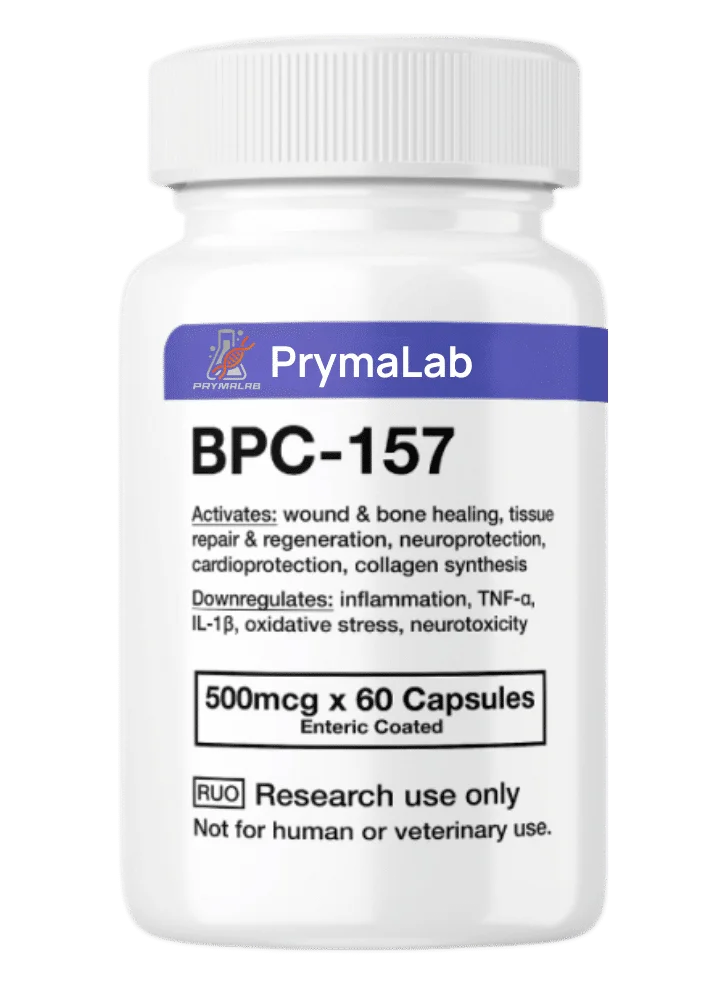
BPC-157 500 mcg Capsules
500 mcg per capsule, 60 capsules per bottle, 30 mg total. Original capsule-batch report available.
- BPC-157 per capsule
- 500 mcg
- Capsules per bottle
- 60
- Total BPC-157
- 30 mg
- Documented lot
- PL-2609-012
Ordering is not yet available. Package quantities describe label contents, not an absorbed human dose.
Are BPC-157 capsules as effective as injections?
A human conversion between oral and injected BPC-157 has not been established. A 500 mcg capsule and a 500 mcg injection describe equal labeled quantities, but that does not make their absorption or effects equivalent.2
| Question | Capsules | Vial or prefilled pen |
|---|---|---|
| How is the amount expressed? | Micrograms per capsule | Milligrams in the container, then concentration and measured volume |
| Is mixing required? | No reconstitution | Powder vial requires preparation; the featured pen is already liquid |
| What does the featured pack contain? | 60 × 500 mcg = 30 mg | Vial: 10 mg. Pen: 15 mg in 3 mL. |
| Can the dose be copied across? | No validated oral-to-injection conversion is available. | |
For a gut-health question, evidence involving delivery into the stomach is more relevant than an injection into a knee. For a tendon question, an oral capsule account is more relevant than an unrelated injection testimonial. Keep the actual route attached to each result.
Do oral BPC-157 capsules help gut health or tissue recovery?
There is experimental support for gastrointestinal effects. In a rat study, BPC-157 delivered into the stomach reduced ulcer area and improved healing in chemically induced gastric-ulcer models. Intramuscular treatment also worked and produced stronger effects in that experiment.3
That study tested rats and experimental preparations. It did not test this bottle, establish a capsule dose for people, or demonstrate treatment of IBS. The broader BPC-157 benefits guide covers tendon, ligament, muscle and joint findings by study.
Has oral BPC-157 been studied in people?
A registered trial, NCT02637284, describes oral tablets intended to investigate safety and pharmacokinetics in healthy volunteers.4 FDA’s review found no posted results or associated publication. A trial registration is not evidence that retail capsules work or have a known absorption rate.2
How long have capsule and oral users reported waiting for effects?
These original public accounts describe different outcomes and timelines. They are self-reports about other products, without controlled comparisons or independent confirmation of healing.
Arm discomfort during a return to training
Capsules · 45-day accountA capsule user described a suspected minor biceps or tendon injury. They reported first noticing improvement around week three and pain-free curls by day 45. Their routine also included high-repetition exercise and progressive loading. A comment identified 500 mcg capsules; the account does not clearly establish the dosing frequency.5
Digestive comfort over two months
Oral route · 2-month accountAnother author reported 500 mcg orally each day and described improved digestion and gut comfort after two months. They also reported fatigue during the first weeks and later unexplained muscle soreness. The exact oral formulation was not specified, so this account cannot establish a result for the featured capsules.6
These timelines do not define a minimum effective cycle. Improvement in comfort, return to activity and structural tissue repair are different outcomes.
How many BPC-157 capsules do people report taking?
The oral accounts reviewed include 500 mcg daily and 500 mcg twice daily. In the twice-daily diary, the author planned eight weeks but posted updates only through days 12–15. They described no clear effect in week one, later improvement in arm comfort and unchanged gastrointestinal symptoms.67
The table translates those quantities into a bottle labeled 500 mcg per capsule. It is inventory arithmetic, not a recommended dosage or a validated treatment schedule. The reports do not establish that this product behaves like the products those authors used.
| Quantity example | Daily total | Weekly total | One bottle lasts |
|---|---|---|---|
| 1 capsule per day | 500 mcg = 0.5 mg | 3.5 mg | 60 days |
| 2 capsules per day | 1,000 mcg = 1 mg | 7 mg | 30 days |
How many capsules would four, six or eight weeks use?
At one capsule per day, those periods use 28, 42 or 56 capsules, containing 14, 21 or 28 mg respectively. At two per day, they use 56, 84 or 112 capsules, containing 28, 42 or 56 mg. The latter six- and eight-week examples require two bottles.
A bottle lasting 60 days does not make 60 days an established cycle. There is no validated capsule-specific course length or break interval; an eight-week plan in a forum is not an eight-week clinical result.
Does gastric stability mean oral BPC-157 is well absorbed?
Stability, release and absorption answer different questions. Stability concerns whether a molecule remains intact under the conditions tested. Release concerns when it leaves the capsule. Absorption concerns how much crosses into the body. A favorable finding for one does not establish the others.
The rat stomach study demonstrates an effect in that model; it does not measure the human bioavailability of a commercial capsule. FDA’s review found insufficient information to assess human pharmacokinetics.2 No absorption percentage or oral half-life is established for the featured product.
Are arginate, acetate and enteric-coated capsules interchangeable?
Do not assume that a different salt, shell or coating has the same release behavior. Ask for documentation identifying the actual formulation and any finished-product testing supporting a delayed-release or absorption claim. The available capsule report does not provide a dissolution test, a human absorption study or evidence that this bottle is superior to another formulation.
Do BPC-157 capsules need mixing or refrigeration?
No reconstitution is required. The capsule batch document specifies 20–25°C, dark and dry; the product directions also call for a tightly closed container. Refrigeration is not the documented storage instruction for this bottle.1
Do not apply a powder-vial mixing chart to capsule contents. The shell and filler belong to an oral formulation; dissolving them does not create an injectable product.
What does the capsule COA actually confirm?
The original report identifies lot PL-2609-012 and certificate PL-26-00012. It reports 99.62% RP-HPLC area purity and a separate content assay averaging 494.7 mcg per capsule from a composite sample of six capsules.1
Purity and content are different measurements. The purity figure describes the measured chromatographic peak areas. The content assay estimates how much BPC-157 was present in the tested composite; it does not show that every capsule individually contained exactly 494.7 mcg.
The report identifies an in-house laboratory, with no outside laboratory report attached. It applies to the named lot and tested samples. Neither the assay nor the purity result establishes absorption, clinical benefits or safety for human use.
Open Original Capsule COAWhat should you compare before buying BPC-157 capsules?
Compare the amount per capsule, number of capsules and total labeled peptide together. A bottle with fewer high-strength capsules is not automatically better value. For this 30 mg bottle, price per labeled milligram is the bottle price divided by 30; price per capsule is the bottle price divided by 60.
Match the actual lot to its report. Look for a capsule content assay, clear shell and filler ingredients, the testing laboratory’s identity and documented storage. A raw-peptide purity certificate alone cannot answer how much is in a finished capsule. Claims such as “best absorbed” need finished-formulation evidence.
Compare all four BPC-157 formats
Review capsule, vial, pen and nasal-spray quantities and available documents.
What else should you know about oral BPC-157?
Should BPC-157 capsules be taken with food or on an empty stomach?
A reliable human food-effect comparison is not available in the reviewed evidence. A forum author’s empty-stomach routine does not demonstrate better absorption. This product’s batch report does not establish a meal-timing protocol.
Can a 500 mcg capsule be split into two 250 mcg amounts?
Opening a capsule and dividing powder by eye does not verify equal peptide amounts. The published assay covers a six-capsule composite; it does not validate fractional portions from an opened capsule.
Are BPC-157 capsules FDA approved or proven safe?
No FDA-approved BPC-157 drug is available. FDA found insufficient clinical safety information, including for long-term use. The absence of a needle does not establish the safety of the peptide or finished formulation.2
What side effects have oral users reported?
Do these capsules contain TB-500 or the Wolverine blend?
No. This bottle is labeled BPC-157 alone. The BPC-157 + TB-500 Wolverine guide covers the separate blend, its component quantities and the reported combination schedules.
Where do the capsule details and reported experiences come from?
- Original capsule COA: PL-26-00012Lot PL-2609-012; contents, storage and analytical results. Capsule formulation details were checked against the published product specifications.
- FDA evaluation of BPC-157 free base and acetateHuman evidence, pharmacokinetics, oral trial status and safety assessment.
- Xue et al. — gastric-ulcer experiments in ratsComparison of intragastric and intramuscular administration.
- NCT02637284 — oral safety and pharmacokinetics trialRegistered study plan; registration is not a published result.
- Original capsule account: arm recovery over 45 daysFirst-person post and follow-up comments.
- Original oral account: digestive comfort over two months500 mcg daily reported; exact oral formulation unspecified.
- Original oral diary: 500 mcg twice dailyEight weeks planned; visible updates cover only the first 15 days.
Product details checked November 2, 2026. Public accounts describe individual experiences and are not testimonials for the featured product.